

One of the biggest challenges I face when drafting a program and making product recommendations to a lawn care company is the notion that the products that I created and sell are going to ultimately deplete the soil due to the low level of inputs that we apply. I believe that this is a perfect opportunity to explain nutrient and carbon cycling and get to the “root” as to why our current fertility recommendations are made. In most cases, the concern is less about the actual depletion of the soil, but the fact that they will be applying allot less NPK than the closest competitor and the thought process goes, “If I apply less, I get less of a return, right?” WRONG! I have explained the Energy in/Energy out method in a previous article. This article goes a much deeper (like our roots), providing a better understanding for you as to why and how our products and recommendations will allow for a broader spectrum of visibility when you look at your overall turf program.
Let’s start here; the idea of soil mining is a proven fact, it does happen and typically it’s an agricultural problem. Because turf science is based in agricultural science, we have accepted this as a truth in our industry. Only in the last 10 years as phosphorus bans have taken hold in many parts of the country has the university level discussion changed. Turf grass, when managed properly does not mine the soil of primary nutrients. In fact, one might even think that even the production of turf grass (sod) would be ultimately depleting because of the amount of topsoil removed every time it’s harvested, again, the opposite is true:
The following table has been reproduced from “Soil Conservation” (Bennett, H.H. 1939. Soil Conservation. McGraw-Hill, Inc., New York. Page 191.)
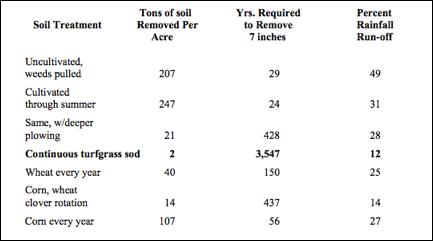
The conclusion was that even with removing sod, organic matter ultimately increased and the soil became healthier. Does this really help in this conversation? Maybe, maybe not. To understand soil mining, you need to go back to the reason that term was invented. I have touched on this before when speaking about active biological products and how they can turn on the soil system, but this is going to be solely predicated on the concept of not applying replacement nutrients. So here we go…
In agricultural harvest practices, material that is grown is removed from the farm and brought to the table. When the removal happens, most everything it took to grow that plant’s fruit or seed is taken with it. Roots, stalks, vines are left behind either on the surface of tilled under ground. The nutrients it took to get that plant to reproduce is ultimately what is hauled off from the soil and needs to be replaced. For allot of people, this is just a widely accepted fact, the problem is in the “replacement” portion. So calculations are made based on harvest and current soil models and the replacement of NPK to get back to the way it “was.” We all know that in agriculture, the main focus of plant growth is NPK. However, should NPK be the main focus of plant growth in turf grass? No, of course not. You can grow aesthetically pleasing grass with high doses of NPK, but you will absolutely spend more on chemical inputs to maintain that much of a system overload.
So here’s the deal, we’ve been told that low nutrient inputs will deplete the soil. While true in part, this claim only applies to the NPK being “depleted” and is as incomplete as an NPK only soil test and a fertility program that is just based on those Macro-nutrients. We on the other hand, create a program for turf that relies minimally on NPK as the force behind health, vigor, and color in turf grass and this facilitates that original question about soil mining. What is the whole truth? Well, that is in the completeness of our fertility programs. The function and beauty of what we do and how we are able to do it and a comparison to the “other guys” is as follows:
First and foremost, we intentionally apply less Macro-nutrients to turf than anyone else. But, we don’t get there over night. We must build a more self-sustaining soil system before we start “leaning” it out. It is important to apply nitrogen and carbon together at all times, this is step one of how we get where we want to go. There is more than enough N when we start our programs that even if we didn’t add the carbon, it would take many years to see diminished results. The carbon additives make all the difference in speeding up a soil system to get it to a place of true “nutrient cycling” where we can shift our focus to a more “environmentally timed” program.
When the soil takes a turn toward health, we start basing the needs of the plant on foliar nutrients and continue to stimulate soil with key components, humates, carbon, carbohydrates, just to name a few. We are also adding in much needed micronutrients at key times of the year when the turf needs a little extra food without creating a growth surge.
The reason the “other guys” load a ton of nitrogen on to turf is to force a bunch of growth and color to show off their work. Why? So customers can tell that they were there. The lawn mowers may or may not like this surge growth and the soil definitely doesn’t like the result. This is the first point to which the failures for the summer take place. These practices produce too much rapidly growing grass, which gets caked up on the surface of the soil or… hauled away. This new supple growth that is loaded with all of the N they just applied and the soil is not getting that back. Since it is more widely accepted that grass should be mulched, we will say that the former is more common. So goes the cycle, more N is needed to push the grass taller to get it above this ever-expanding area of thatch that just won’t break down. Copious amounts of P and K are added to maintain this stacked up lawn. And all of this is simply solved by reducing the fuel (NPK) inputs.
Now, once we hit that tipping point of thatch overload, it takes a little time and work to get back to a sustainable system, but it’s worth it. There is a season’s worth of nutrients in that thatch layer if it is properly taken down. And what’s required is feeding the plant tissue what it needs to thrive and the soil what it needs to become self-sufficient again. This is why the D-Thatch came into play, coming out of Spring surge growth, applications of D-Thatch in late Spring and Early summer allow for a more rapid digestion and assimilation of nutrients before that layer becomes an issue.
We’ve proven for years that “Soil Mining” must be redefined. It needs to be called out as a true misnomer and reversed onto the original doubters. Soil Mining by definition should be “depleting the soil of carbon beyond the point of sustainable levels.” This is truly what happens in a heavy NPK program, the roots don’t form the way they should and the growth is all about what’s above ground. The actual carbon and OM becomes depleted in order to support all of that unsustainable top growth and eventually hardens out, making the soil incapable of replenishing itself to support the bounty of plant life growing on its surface. I see this every day in the field and it doesn’t have to be like that. We have proven over the years that soil management comes from looking not just at a soil sample, but at all aspects, rainfall, temps, turf types, soil types and so forth. Viewing the entire ecosystem in and on the soil allows for program adjustments based on the whole picture including, soil, vegetation, cultural practice, environmental factors, etc. not just what the extension office soil test says.
John Perry
President/CEO Founder
Greene County Fertilizer Company, Inc. and its parent company, Bio Green USA, Inc.
Contact John Perry with your Lawncology® questions, comments feedback here.

0 Comments