

2015 was a strange year in many parts of the US. With the East Coast holding snow until July, the Alpine West seeing temps in the 60’s through the winter, multiple massive rain events in the south, mid-south, mid-west, and drought in the extreme west, people who love to talk about weather have compiled more stories this year than in their lifetime. This Lawncology® is not about arguing the sides of climate change; it’s about adapting lawn and plant programs to cope with different weather or seasonal events. I will start with what I think is the biggest environmental detriment to lawns and our industry and work down the list.
Drought.
Drought is one of my favorite topics because so much has to be taken into account. The biggest thing about drought to take into consideration is time between rain events. There are many ways to keep grass healthy if there is at least SOME water. In areas where 100% blackout on watering is necessary and you have no rainfall, the only thing to do is wait until the grass is dead and go through its pockets for loose change.
Seriously though, a drought is an excellent opportunity to drive roots deeper. This is what is going to preserve the life of whatever plants you are trying to maintain. The soil profile has a cooling effect on the plants once the roots get to a deeper level. This is needed for any plant to make it through the long hot summer. Starting a Low N program with 0-0-2, 4-0-2, or 5-0-1 can make life much better for anyone who does not want to replace their lawns at the end of a dry summer.
By driving down the roots you will accomplish additional benefits,
- Breaking up the soil for greater water penetration in clay type soils
- Capturing and holding more water in sand based soils, in other words, slowing down drainage.
- Increased plant available water in all soil types
- Greater pathways for nutrients to travel and untapped resources of previously unavailable nutrients in deeper soil profiles.
- Building up of more organic matter when the roots begin their shedding process.
All of these will aid in recovery and general health and appearance of a lawn through the dry times.
Northern Regions, Warm winters.
It has been my observation over the last decade that where there is a warm winter or a lack of typical turf dormancy, lawns have a hard time waking up and getting the green that clients (and us) in the business want to see. This brought me to a rather simple conclusion, Nitrogen deficits due to lack of soil rest. This is actually an easy thing to overlook. Based on the industry, there are typical models of suggested Spring fertility that never take into account the effects of a dry, warm, or non-hibernative winter.
If the soil doesn’t fully rest, the soil life will continue to process and send nutrients to partially awake plants. This will cause the “bank” of fall Nitrogen to be depleted before Spring. An adjustment to rates and timing of products has to be made to remedy this. Running 20+ for rounds 1, 2, & 3 will be what is needed to keep color and not have a fall off. Pay attention to weather patterns in your markets over the winter so that we can get the appropriate products and application rates down early in the Spring for best results.
Heavy Rains/Flooding
While in a normal year this is only reserved for certain small parts of the country, we have seen widespread heavy rain events that have caused billions in property and crop losses in a very short time. Indiana had 30 inches of rain in 30 days, parts of Florida have had 36” in the last 30 days, Texas, Oklahoma, and other southerly States had up to 48” of rain this summer.
I’m going to reduce this to as basic a description as possible. Heavy rain is a blessing and a curse, it has the ability to cleanse soil systems and recharge water supplies, as well as bring in all sorts of exciting diseases and problems. After a rain event, the roots of the turf have undergone intense shock in the way of de-oxygenation. The purpose of roots as we read earlier is to move nutrients and water through the system. When water has filled every pore and channel of a root, there is nothing left for a plant to do but either, drown, disconnect the root, or hopefully hold out for sunny weather.
In this type of situation, Nitrogen is not your friend. For every inch of rain, nearly a 1/4lb. of N falls per acre. In a balanced ecosystem, this is enough to sustain plant life. Adding N to this wet scenario will cause these issues:
- Fungus
- Root rot
- Weed pressure
- Insects pressure
All of these are caused by an already stressed plant sending off a distress signal because it cannot process ammonia after being de-oxygenated for any long period of time. Now you’ve got problems. The fungus will latch on to that N and go nuts, the grass will begin to lay down and weeds will pop up. Insects will attack the weakened bio-mass with a hunger for easy prey. Care must be taken to slowly bring the health of the system back. Multiple apps of 0-0-2 have shown themselves to be the best way to bring grass back after drowning for any long period of time.
As always, roots are the answer. With roots, more and deeper is always better. Increased root mass and depth increases turf’s ability to respond to ever-changing rain and climate events. We have clients that have standing water in their lawns for half the year without ever seeing damage when it does finally dry out. Others go weeks without water without seeing a sign of stress. Roots will outrun most issues in turf grass when managed properly. We have seen chemical usage drop dramatically the longer a lawn has been on our program and that is simply due to the roots self-regulating the system. Healthy Roots, Healthy Shoots, Healthy Turf Under Your Boots…
⌘
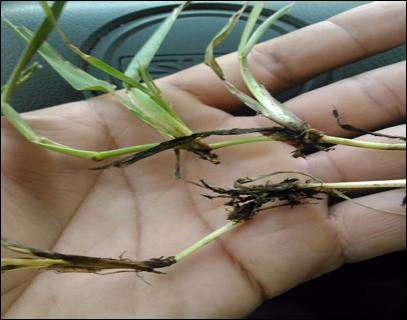
Figure 1 Typical result of sitting in water for a long period of time. (Floritam August 15) root rot.
John Perry
President/CEO Founder
Greene County Fertilizer Company, Inc. and its parent company, Bio Green USA, Inc.
Contact John Perry with your Lawncology® questions, comments feedback here.

0 Comments