

During our Lawncology® Summit in Atlanta and then again at a Cattlemen’s meeting later that week, the subject of surface area and how it pertains to soil health came up. Well, it didn’t just “come up,” I was off on a tangent about something else entirely when it popped into my head. Nonetheless, I feel it is a timely topic for those of you who are ending the season with aeration and over seeding and a wonderful topic for all of you wishing to understand the soils’ ability to fracture.
We all know what happens to plants in tightly bound soils. Nutrients have a hard time moving. Water cannot drain, infiltrate, percolate, or be utilized as quickly or as efficiently. Root systems struggle to get to depths needed to help aid in drought, heat or frost stress. Soils have the innate ability to pack, heave, crack and really do whatever is needed to stay alive. That may seem like a strange statement, “soil trying to stay alive.” But the reality is that the soil is in control of what is growing in it at all times. If soil dies; plants die. It is a remarkable cycle that allows for tremendous changes in the world around us.
If you think macroscopically, how often do you see natural grassland growing on the sides of steep mountains or hills that weren’t put there or deforested by man? There is even a degree of slope where the soil will dictate what should grow there naturally. In areas where soils are loose and mobile, you will see more grasses and shallower rooting plants; on hillsides you will see trees, slow growth shrubs, less grass, more roots. This is the same phenomenon that exists along rivers and creek beds. Trees will make every attempt to keep the water from stealing the soil. There are no mistakes in nature as to where and why things grow.
So let’s jump back to surface areas and move towards a better understanding of why it is important to keep this concept in mind when dealing with soils’ abilities to use and transfer nutrients. In the graphic below (left), you see a cube. For this illustration, the first cube is clay. The second is clay loam. The third is sandy loam. And the fourth is sand. The split in the particle size is what is important to understand. Each of these soils has different and unique ways of transferring water/nutrients/cations because of the density and space between molecules. The greater the space (surface area of particles) the more transference will take place.

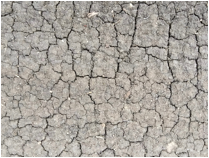
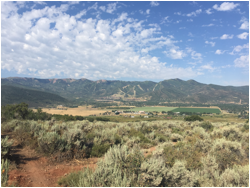
As I mentioned in Atlanta, one of the best ways to see a soil’s adaptability to stress and to have a macroscopic view of what’s happening below ground, is to look at dry cracked soils and see what they are trying to do to get ready for the next rain. The image above (right) is a great example of clay loam soil that I took while hiking in the Wasatch Mountains after roughly 2 weeks without rain. The soil had moisture, and then dried up, and the result was a fracturing on the surface. Two more weeks without water and this turned into “Moon Dust.” The particles became so fine that the result was a dust cloud when you walked through. The soil in its moist or stable form is highly compacted. This is topsoil on the side of a mountain, a very shallow profile and therefore very dense. Millions of year ago, the rich topsoil eroded down to the valley below (pictured.) This is a beautiful example in how a soils natural response to drought is to fracture as many times as possible to take advantage of any moisture that may become available.
When it’s the time of year to start aerations, the concept isn’t so much aerating (adding air though that is what you are doing); it is so, so much more. The importance of mechanical aeration truly varies with soil types and what additional services are being applied with it. Seed germination should increase with mechanical aeration, as well as drainage (temporarily) but weed count and fungus can show up as well. When discussing aeration, the subject of spreading biotic agents is rarely considered. Likely this is because they aren’t active at the time of aeration. It is of reasonable importance to remember that most fungi live on top of the soil and under the thatch; you are inevitably bringing fungi to the surface and giving them an opportunity to flocculate the next season.
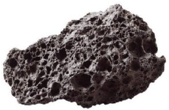
On the plus side, any fracturing of tightly bound soils gives more air, more water, and by default more ability for a plant to use soil nutrients. While roots don’t need oxygen, soil life does. One of the ways we facilitate this function in soil with our model of fertility is through the addition of humates and root development. Organic or natural aeration will ALWAYS last longer and be more effective than mechanical aeration. It’s easy to understand how root development will fracture soil and create more surfaces (this is evidenced in roots’ ability to break rocks), but not many people understand the humate portion. Because the base of our humic acid is leonardite, we are using a lignite that is a precursor to coal. This particular material is highly porous.
The image below is actually of pumice, but the microscopic view of leonardite is similar. Each and every hole and pocket is an additional surface for air/water/and nutrients to hide and move when needed. When we apply this to the soil with every application, we are creating a naturally aerated state in which soils can do what they are supposed to do, even in heavily landscaped environments.
⌘
John Perry
President/CEO Founder
Greene County Fertilizer Company, Inc. and its parent company, Bio Green USA, Inc.
Contact John Perry with your Lawncology® questions, comments feedback here.

0 Comments