

In the 1800’s, New York City was facing a crisis. The population exploded from 60,000 people to 1.5 million from 1800 to 1890. This brought a lot of quick and ill planned expansion to the city. People were growing families and businesses and the need to move more and more goods into the city was creating traffic and noise. In those times, everything in the city moved by horse. Wagons and carts dominated the scene, even the first “trolley” was pulled by horse.
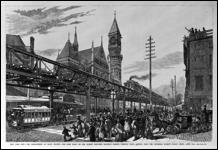
The leaders of the city were faced with an unexpected reality; the horses were creating air pollution. The smell and noise from all of the “traffic” had become so bothersome that people were passing out in the street because of the “exhaust.”
Enter the automobile. As soon as the first “horseless carriage” hit the city, they had their solution. Ban the horses in the city and make people transport and commute with cars. This was brilliant… at the time. Before long, horses were no longer seen and the automobile took over.
This is a very interesting concept when we look back… cars to solve pollution. Today, in reality this is far from a good idea. If someone told you the way to get rid of air pollution is to drive rather than walk, you would probably laugh them out of your office. But this was the reality of the time. So how does this have anything to do with lawn care? I’m getting to that.
Not long after this time frame, (late 1890’s) chemical fertilizer entered the scene. The great minds of the time were grappling with low production of crops and concern that the world population would out pace food production by 1950. During this time, there was a lot of creativity in how to boost crops with organic sources of nutrients. The problem was that the same items were being harvested for gunpowder and explosives. With the invention of the Haber-Bosch method and the sudden surplus of free nitrogen after the war, thoughts went right back to food and crop production.
The initial trials with ammonium nitrate on fertile ground made the scientific and agronomic community jump for joy. Row crops became hyper productive and the food shortage was temporarily solved. Even with the expanded crop harvests, farmers were slow to turn. A phrase that we hear today that is definitely handed down through the generations is “my daddy farmed this way, his daddy farmed this way, so I’m gonna farm this way.” At the time, that was the saying to keep the synthesized products off their property. Now, trying to get them to relinquish them is a challenge.
So what happened next, modern farming was born and with it a plethora of problems no one saw coming. The ground became hard, the dust bowl occurred; yields went back to pre-war levels. Small choice, big repercussions. What happened next? GMO. We don’t yet know what this is going to do to our environment and there is too much controversy to mention it here. The only reason I bring it up is that perhaps we are looking at the next mistake chalked up to “seemed like a good idea at the time.”
Now to us as an industry. The horticultural and service industries for lawn care have closely mirrored that of agriculture. The basic practices, chemicals, feeding schedules, all come from that industry. As a whole, no major discoveries have been made in our business. Sure there are certain small items to improve on terrible efficiencies, but if you think about it what is really being contributed? Example: slow release nitrogen was hailed as a game changer. Really? Why is that? Today, every major chemical company is trying to slow down releases to absurd levels. The interesting thing is that “organic” nitrogen is as slow as it gets and is treated like witchcraft.
Perhaps the reason that we haven’t made great strides is because it’s all perspectives rather than necessity. If it looks good, if it kills the weeds, if the bugs die, it’s fine. But if we view the comparisons, it’s very interesting. How many different types of turf are being cultivated? What are the real differences? How long before the reason one type was created no longer works? Can anyone say Floritam?
So let’s talk real environmental impacts. No matter what side of the aisle you are on with respect to climate change; real or not, there are things that we have done in the past that are definitely having an impact on our present. Everything seemed like a good idea once, hindsight is 20/20, so what do we do now to not repeat the mistakes of the past? Think globally, act locally.
Bio Green® and Greene County Fertilizer Company products are designed to work with nature and man. We can enhance synthetic and natural programs. We stand alone. We work together. We build bridges and fill holes. We bring balance. We transform conditions. We change minds. We give the customer what they want and know that we didn’t contribute to run off. We have the ability to capture atmospheric nitrogen and carbon dioxide and place it in the soil where it belongs. Our little lawn apps are impacting the environment every day. Imagine what we can do in 5, 10, 20 years? The amount of atmospheric and waterway change will be dynamic.
So, perhaps we just service lawns and send bills. Maybe we just show up and do good work. So what if this is your intention? It doesn’t matter. Your use of Bio Green® or Greenefield™ is making an impact. You can sleep soundly at night knowing that you aren’t “fixing” a problem, you are the solution. Thank you.
⌘
John Perry
President/CEO Founder
Greene County Fertilizer Company, Inc. and its parent company, Bio Green USA, Inc.
Contact John Perry with your Lawncology® questions, comments feedback here.

0 Comments